Well Pump Costs and Replacement
Why Pulling a Deep-Well Pump Can Affect Labor
When people think about a well pump job, they picture the pump. But on a deep well, getting the old pump out — and the new one back in — is often the largest part of the work. Understanding why retrieval is so labor-intensive explains a big share of any deep-well estimate.
It's a useful shift in thinking: the pump is the part that failed, but the labor is mostly about the distance between that part and the surface. On a shallow system that distance is small; on a deep well it's the defining feature of the job. Once you see retrieval as its own task — separate from the pump itself — the way estimates are built starts to make sense.
Everything Comes Up Together
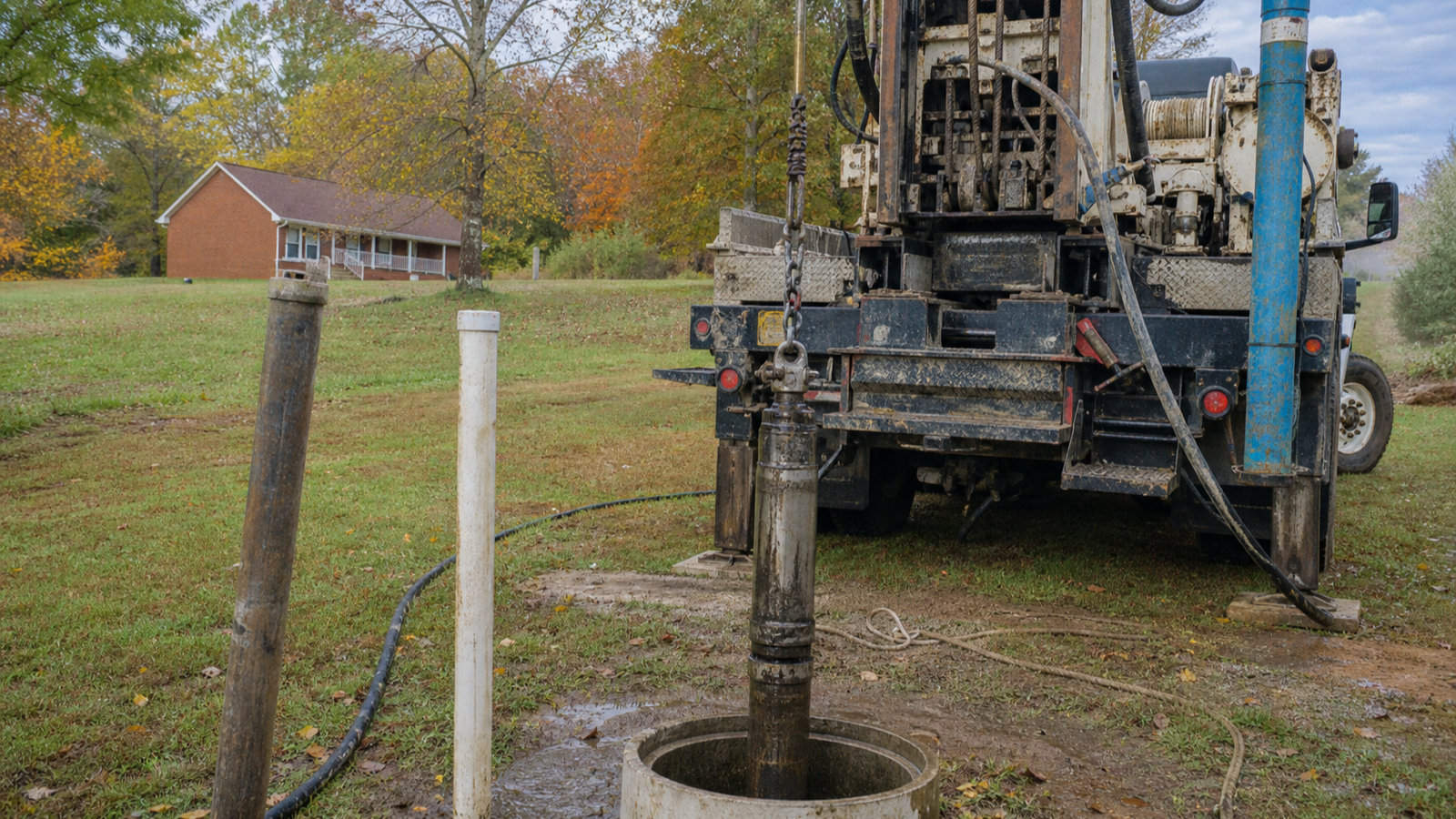
A submersible pump hangs near the bottom of the well on a continuous run of drop pipe, with the electrical wire strapped alongside. To reach the pump, the entire string — pipe, wire, and pump — has to be pulled up out of the well. On a deep well that's hundreds of feet of assembly, brought up carefully and in order, then lowered back down the same way with the new pump. There's no shortcut to the pump; the whole run comes with it.
Why It's Careful, Physical Work
- Weight — a long column of water-filled pipe, wire, and pump is heavy to lift from depth.
- Care — nothing can be dropped down the well, so each section is handled deliberately.
- Equipment — deeper wells often require pulling equipment rather than doing it by hand.
- Reassembly — the new pump goes down the same way, connections made as the string is lowered.
What Can Complicate a Pull
Not every retrieval is straightforward, and a provider can't always know in advance what a well will do. Older galvanized drop pipe can be corroded and brittle, making it slower and more delicate to bring up than modern pipe. Mineral buildup or scale from hard water can leave a pump snug in the casing, and a pitless adapter or fittings that have aged in place may resist separating. Occasionally a well has debris or an obstruction that has to be worked around. These are the kinds of conditions that turn a routine pull into a longer one, which is part of why an honest estimate acknowledges that a deep-well job can hold surprises until the string is actually moving.
Why This Drives the 'Repair or Replace' Decision
Because retrieval is the expensive step, it changes the math on repairs. If a deep-well problem requires pulling the pump anyway, much of the cost of a full replacement is already being spent — so reinstalling an old pump, only to pull it again soon, can be poor value. This is why, when the pump is already out of an aging system, replacing it often makes sense. Our guide on repairing versus replacing a well pump covers the decision.
What Reduces the Labor
A few things help: good access to the well head so equipment can reach it, a known well depth and pump setting so the job is scoped accurately, and addressing related components while the pump is out rather than in a second visit. Keeping the well head accessible and your well records handy pays off here — see our guides on locating the well head and well-system records. When you request service, note the depth if you know it and ensure the well head can be reached.
Related Well Pump Services
Upper Cumberland Well Pump is an independent referral service that helps connect property owners with local water-well and pump-service providers. Upper Cumberland Well Pump does not directly perform regulated well drilling, pump installation, pump repair or water-treatment work unless expressly stated. Provider licensing, qualifications, insurance, availability, pricing, scheduling and service terms must be confirmed directly with the provider.
Well Pump Costs and Replacement — Questions
Why is pulling a well pump such a big part of the job?
Because a submersible pump hangs near the bottom of the well on a long run of drop pipe with wire alongside, and reaching it means pulling that entire assembly up — hundreds of feet on a deep well — then lowering the new pump back down the same way. It's heavy, careful work that's often the largest labor component.
Does every well pump repair require pulling the pump?
No — many repairs are at the surface (pressure switch, tank, wiring) and don't touch the well. Pulling is required only when the problem is the pump, drop pipe, wire, or check valve down the well. When pulling is required, depth heavily influences the labor.
Why replace the pump if it's already pulled?
Because the costly retrieval labor is being spent regardless. On an aging system, reinstalling an old pump only to pull it again soon can be false economy, so replacing it while it's out is often the better value. A provider advises based on the pump's age and condition.
How can I reduce the labor of a deep-well job?
Keep the well head accessible so equipment can reach it, have your well depth and pump setting records handy so the job is scoped accurately, and address related components in the same visit. Good access and records make retrieval more efficient.
Need Help With a Well Pump Problem?
Send the property location, a description of the problem, any recent changes in pressure or water flow, the location of the well head and several clear photographs of the visible system components for an initial service review.