Maintenance and Service Planning
What Photos Should You Send Before Well Pump Service?
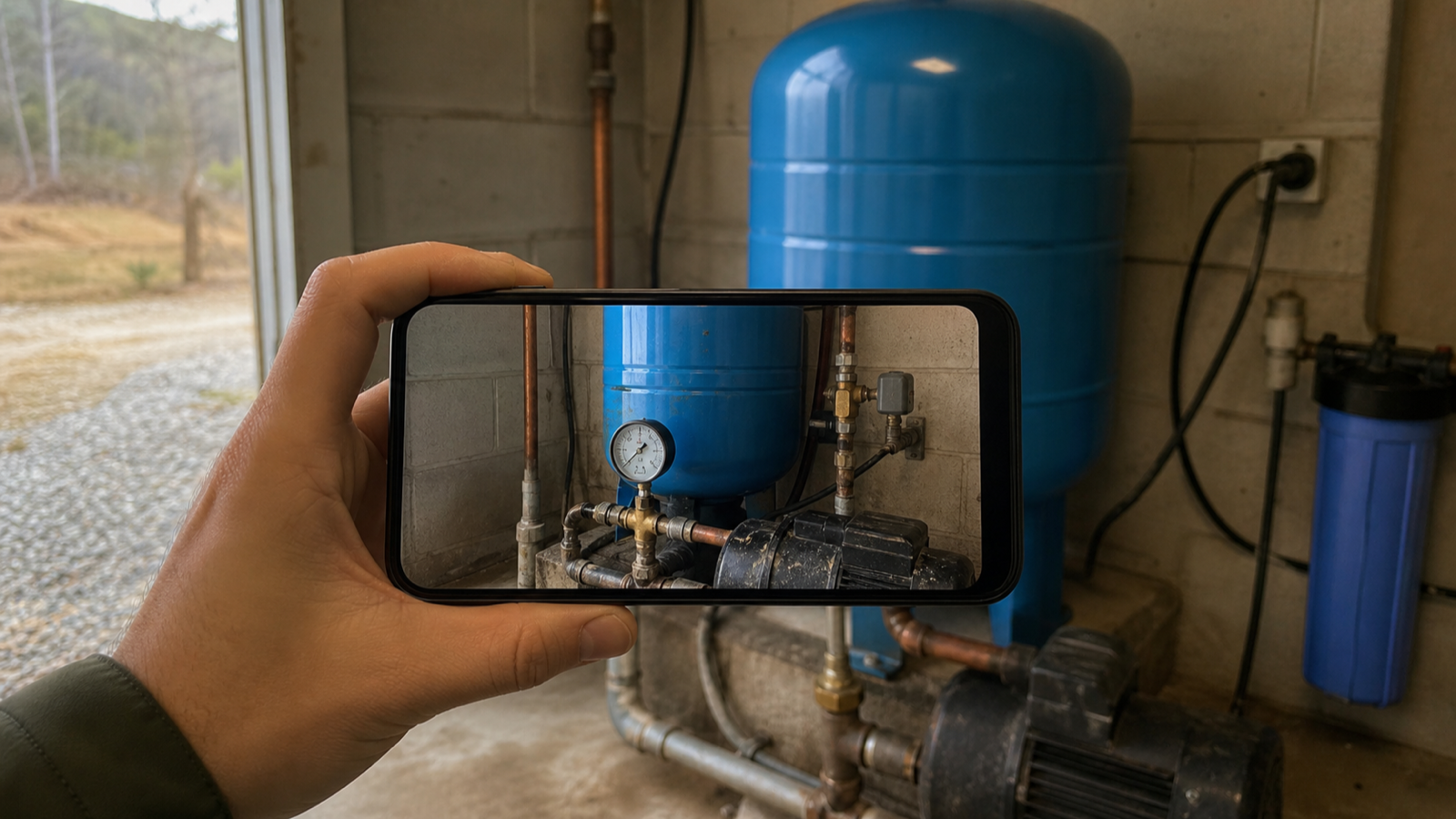
A few clear photos can tell a well-service provider more than several minutes of description. Images capture the type of equipment, its condition, the surrounding layout, and access details all at once. When you send useful photos with your request, a provider can often arrive better prepared and spend less time simply figuring out what they are working with.
The goal is to photograph what is safe and visible from the outside. You never need to open, unscrew, or disassemble anything to take a helpful picture.
Why Photos Are So Useful
Well systems vary widely from property to property. One home may have a submersible pump feeding a pressure tank in a basement, while another has a jet pump in a well house and a tank in a crawlspace. A photo instantly shows which situation a provider is walking into, which helps with planning parts, tools, and time.
Photos also document condition. Rust, corrosion, dampness, or an aging tank are all visible in an image, giving a provider context before the appointment even begins. That context can be the difference between arriving with the right components on hand and needing a second trip.
Photos Worth Sending
- Take a wide shot of the well head or well house showing its surroundings, so a provider understands the setting and how to approach it.
- Photograph the pressure tank from a few feet back, capturing its size, color, and any visible labels or fittings.
- Capture a clear, focused image of the pressure gauge so the reading is legible, since the number often hints at what the system is doing.
- Take a picture of the electrical disconnect or control box from the outside without opening it, showing its location and general condition.
- Photograph the path from the driveway to the equipment, including gates, slopes, or narrow spots that affect access.
- Include a close-up of any visible model or serial plates you can read without moving or opening components.
What Not to Photograph or Touch
Do not open the well cap, remove the control box cover, or take apart any pressurized or electrical component to get a picture. These parts can carry serious safety risks and should only be handled by a licensed provider. A photo of the closed, intact equipment is exactly what is needed.
If a component is hard to reach or you feel unsure, simply skip it and note that in your message. A provider would rather have a safe partial set of images than have you take any risk to complete the collection.
Sending Photos With Your Request
Good lighting makes a big difference. Photograph during the day or use a flashlight so details are visible, and hold steady for a sharp image. Several angles of the same component can help more than a single distant shot.
You can attach these photos when you submit a service request so a qualified provider reviews them ahead of time. Clear images paired with a short written description give the strongest possible starting point.
Related Well Pump Services
Upper Cumberland Well Pump is an independent referral service that helps connect property owners with local water-well and pump-service providers. Upper Cumberland Well Pump does not directly perform regulated well drilling, pump installation, pump repair or water-treatment work unless expressly stated. Provider licensing, qualifications, insurance, availability, pricing, scheduling and service terms must be confirmed directly with the provider.
Maintenance and Service Planning — Questions
Is it safe to open the well cap for a better photo?
No. The well cap protects the system and should stay closed. Photograph it intact from the outside. Any work that requires opening the cap belongs to a licensed provider with the right training and equipment.
What if it is too dark to get a clear photo?
Use a flashlight or the phone's light, or wait for daylight if the equipment is outdoors. A blurry or dark image is hard to use, so a clear shot from a safe distance is better than a close one you cannot make out.
How many photos should I send?
There is no fixed number. A handful of clear images covering the well head, tank, gauge, and access path usually covers the essentials. It is better to send a few useful angles than many blurry or repetitive shots.
Need Help With a Well Pump Problem?
Send the property location, a description of the problem, any recent changes in pressure or water flow, the location of the well head and several clear photographs of the visible system components for an initial service review.