Well Pump System Components
Submersible Well Pumps Versus Jet Pumps
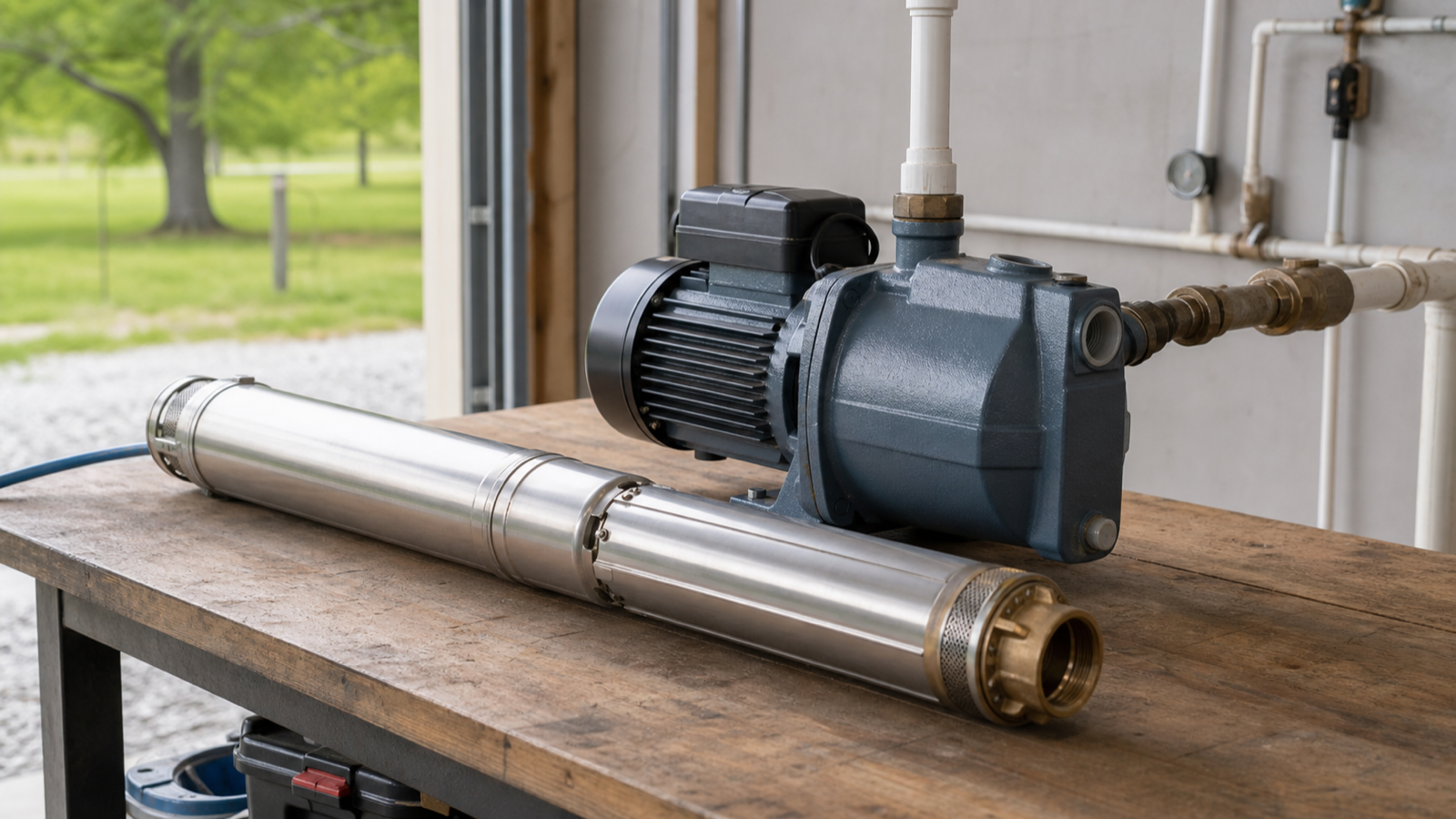
Most private wells rely on one of two pump designs: a submersible pump that lives underwater inside the well, or a jet pump that sits above ground and draws water up. Both move water to your home, but they do it in very different ways, and the type you have shapes how the system behaves and how it is serviced.
Knowing which kind you have helps you understand where noises come from, what a service visit involves, and which symptoms to watch for. Here is how the two compare in plain terms.
How each pump moves water
A submersible pump is a sealed, cylindrical unit lowered deep into the well, below the water line. It pushes water up to the surface. Because it is already submerged and pushing rather than pulling, it works efficiently in deeper wells and tends to run quietly since it is far underground.
A jet pump stays above ground, often in a basement, well house, or crawlspace. It uses suction to pull water up from the well. Shallow-well jet pumps handle modest depths, while deep-well jet configurations use a second pipe and a jet assembly down in the well to extend their reach. Because it relies on suction, a jet pump must maintain prime, meaning it needs water in its housing to operate.
Key differences at a glance
- Placement differs sharply: a submersible pump is hidden inside the well casing, while a jet pump is visible and accessible above ground.
- Depth capability favors submersibles, which are commonly used in the deeper wells found throughout much of the Upper Cumberland region.
- Priming is a jet-pump concern only; if a jet pump loses its prime it can run without moving water, whereas submersibles stay submerged and do not need priming.
- Servicing access is easier for jet pumps since they are above ground, while reaching a submersible pump means pulling it and the drop pipe out of the well.
- Noise tends to be lower with submersibles because they operate deep underground, while jet pumps are audible in the space where they are installed.
How each type tends to fail
Submersible pumps often show trouble through weakening pressure, tripped breakers, or a pump that runs but delivers little water. Because they are sealed and underground, diagnosing them usually means a provider evaluates the electrical readings and, if needed, pulls the unit for inspection.
Jet pumps more commonly struggle with lost prime, air in the lines, or worn internal components that reduce suction. Since they are accessible, a licensed provider can often assess them without removing anything from the well. In either case, the underground and electrical parts are not homeowner territory.
Which one is right for a given well
The best choice depends on the well's depth, the water demand of the household, and the existing setup. Deeper wells generally point toward submersible pumps, while some shallow wells are well suited to jet pumps. Replacing one type with another is a significant decision that a qualified provider should guide.
If your pump is aging or underperforming and you are weighing your options, our well pump replacement page explains the service, and you can request a provider to assess your specific well before any decision is made.
Related Well Pump Services
Upper Cumberland Well Pump is an independent referral service that helps connect property owners with local water-well and pump-service providers. Upper Cumberland Well Pump does not directly perform regulated well drilling, pump installation, pump repair or water-treatment work unless expressly stated. Provider licensing, qualifications, insurance, availability, pricing, scheduling and service terms must be confirmed directly with the provider.
Well Pump System Components — Questions
Which pump type is more common in the Upper Cumberland area?
Many wells in the region are relatively deep, which often favors submersible pumps, but plenty of shallower wells use jet pumps. The only reliable way to know what you have is to look at the equipment or have a provider confirm it.
Can I switch from a jet pump to a submersible pump?
It is sometimes possible, but it is a major change that depends on the well's construction, depth, and wiring. A licensed provider should evaluate whether a conversion makes sense for your well rather than assuming it will.
Why does my jet pump lose water pressure after sitting unused?
This often points to a loss of prime or a leak that lets water drain back, which a suction-based jet pump is especially sensitive to. A qualified provider can find the source, since a check valve, foot valve, or seal may be involved.
Need Help With a Well Pump Problem?
Send the property location, a description of the problem, any recent changes in pressure or water flow, the location of the well head and several clear photographs of the visible system components for an initial service review.