Rural Well and Pump Projects
Well-Pump Considerations for Long Water-Line Runs
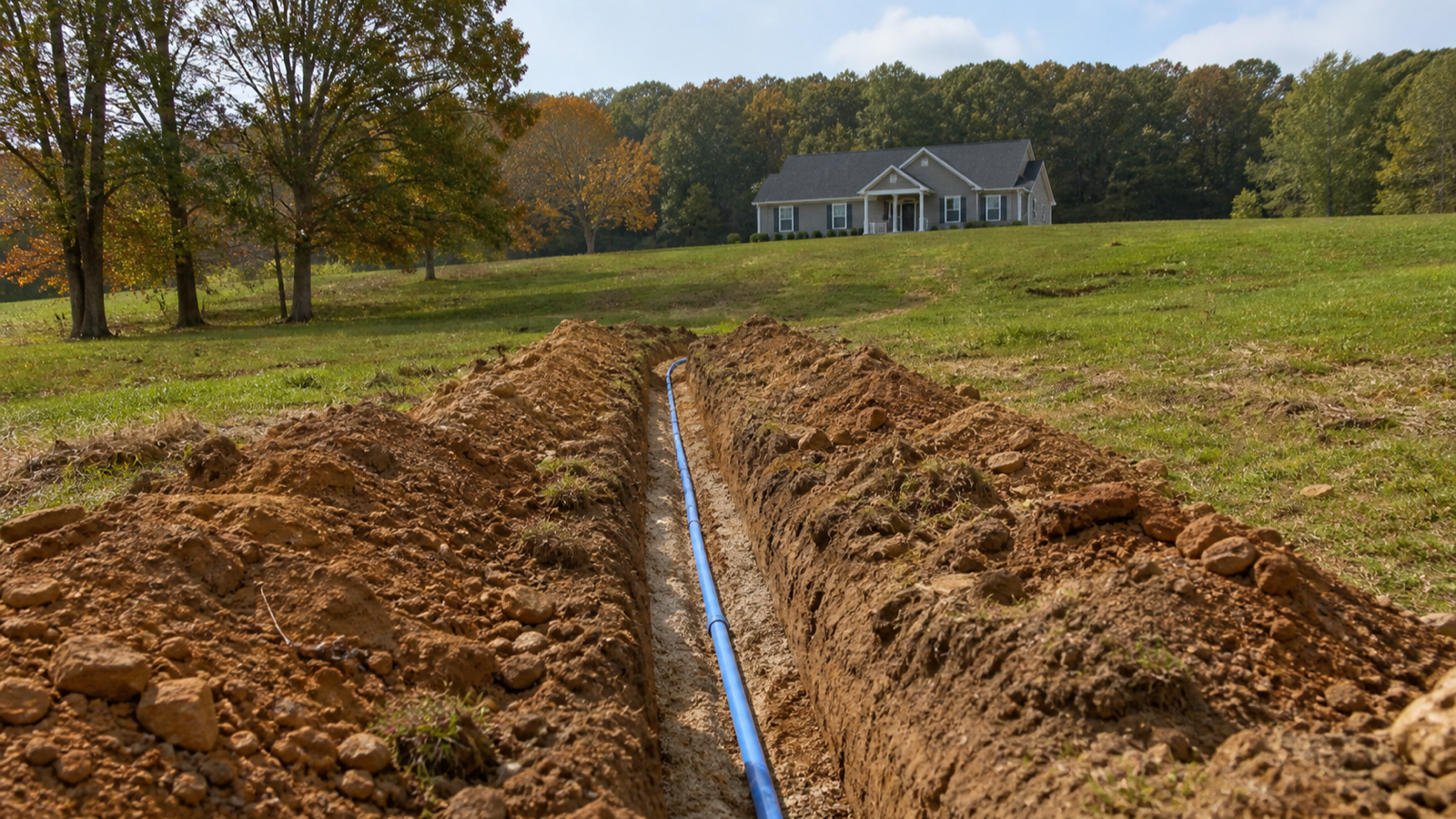
On rural acreage, the well and the home are not always close together. A well may sit hundreds of feet from the house, across a field or up a slope, and that distance has real consequences for how the water system performs. Long water-line runs are common across the Upper Cumberland, where properties are large and the best drilling spot is not always near the door.
This guide explains how distance affects pressure and pump sizing, and what to plan for when your water has a long way to travel.
Why Distance Reduces Pressure
As water moves through a pipe, friction against the pipe walls steadily reduces pressure. The longer the run, the greater this cumulative loss, which is why a fixture far from the source can feel weaker than one nearby even when the pump is healthy. This is a matter of physics, not a fault in the equipment, and it must be planned around.
Elevation compounds the effect. If the home sits uphill from the well, the pump must overcome both the friction of the long run and the vertical lift. Both factors together determine how hard the pump has to work to deliver usable pressure at the far end.
Line Sizing Is the Main Lever
The single most effective way to manage a long run is proper pipe sizing. A larger-diameter line reduces friction loss, preserving more pressure across the distance. Undersizing a long buried line is a common and costly mistake, because water arrives at a trickle and the only real fix is to dig it up and replace it.
The right size depends on the length of the run, the elevation change and how much water needs to flow. A qualified provider can calculate this rather than rely on a default, which is well worth doing before a long line goes in the ground.
Planning a Long-Run System
- The total distance and elevation change from the well to the home, since both contribute to pressure loss over the run.
- Line diameter chosen to limit friction loss across the full length, rather than a default size that may starve distant fixtures.
- Pump capacity matched to overcome both the friction of the run and any vertical lift while still delivering usable pressure.
- Whether a constant-pressure system would help hold steady pressure at the far end as demand changes through the day.
- Adequate burial depth below the frost line for the full run, protecting the long line through hard regional winters.
Matching the Pump to the Run
A pump serving a long run must be sized with the distance and elevation built into the calculation, not treated as an afterthought. In some cases a constant-pressure system helps by maintaining steady pressure at distant fixtures as demand fluctuates. Whether that fits your situation depends on your layout and how the water is used; you can read more at /constant-pressure-well-pump-systems/.
Because long runs leave little margin for error, they reward careful design by an experienced provider. When you are planning a system with significant distance between the well and home, you can request service at /request-service/ to have the run assessed properly.
Related Well Pump Services
Upper Cumberland Well Pump is an independent referral service that helps connect property owners with local water-well and pump-service providers. Upper Cumberland Well Pump does not directly perform regulated well drilling, pump installation, pump repair or water-treatment work unless expressly stated. Provider licensing, qualifications, insurance, availability, pricing, scheduling and service terms must be confirmed directly with the provider.
Rural Well and Pump Projects — Questions
How far can a well be from the house before it becomes a problem?
There is no single distance limit; instead, longer runs simply require larger pipe and careful pump sizing to offset the added friction loss. Elevation change matters as much as distance. A provider can calculate what the specific run needs so pressure stays usable at the home.
Can I fix weak pressure caused by a long line without digging it up?
Sometimes adjustments at the pump or pressure system help, but if the buried line itself is undersized for the distance, the friction loss is built in and hard to overcome without replacing the line. That is why getting the diameter right before burial matters so much. A provider can diagnose whether the line or the pump is the limiting factor.
Does elevation matter as much as distance on a long run?
Both matter and they add together. Distance causes friction loss along the pipe, while an uphill home adds vertical lift the pump must overcome. A run that is both long and uphill places the greatest demand on the system, which is why these factors are calculated together during planning.
Need Help With a Well Pump Problem?
Send the property location, a description of the problem, any recent changes in pressure or water flow, the location of the well head and several clear photographs of the visible system components for an initial service review.